I went on a Buddhist meditation retreat expecting insight, clarity, and maybe a little enlightenment.
What I did not expect was to discover that I am a much fussier eater than I ever knew.
The food was a daily spiritual practice in itself. Beans with everything. No butter. Ever. Breakfast involved a lumpy, gloopy porridge that appeared to have been assembled with good intentions and very little concern for texture. All the soups — and there were many — shared the same uncanny consistency, except for the mushroom one, which was the colour of mould and had the texture of frogspawn.
I briefly considered smuggling in sausage rolls.
I didn’t.
I would like some credit for that.
The Performance of Being Spiritual
There’s something I don’t often admit: I can feel quite self-conscious about not being “true” to myself.
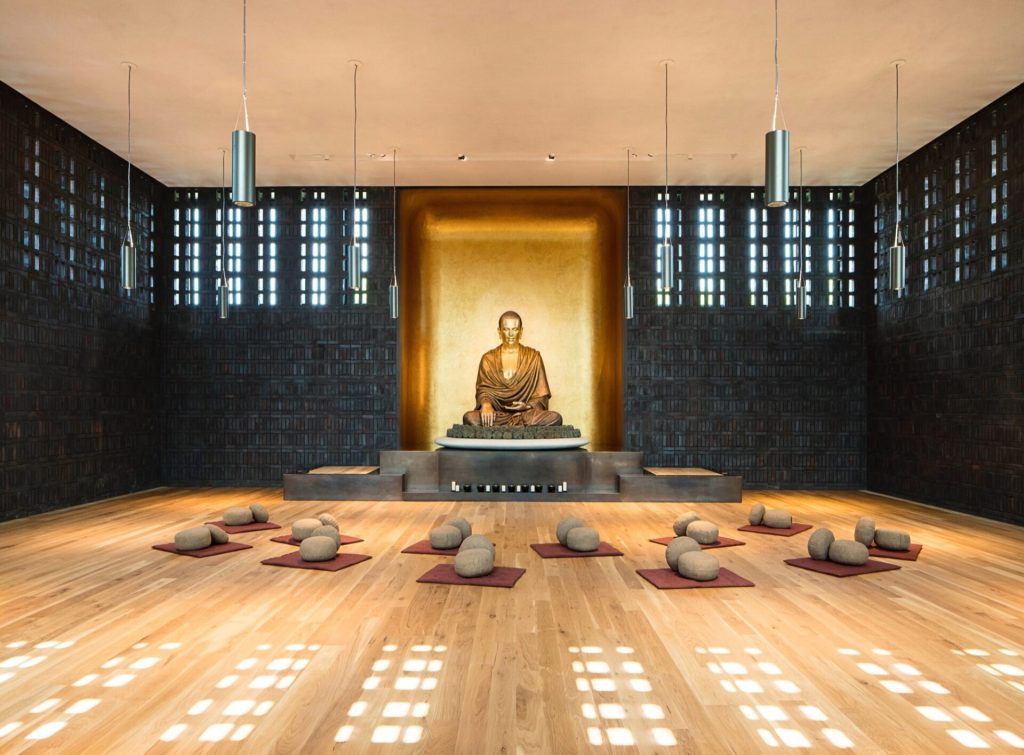
This became very apparent during a Buddhist ritual involving lighting a candle, offering it to a large and very beautiful golden Buddha, gently waving it around, and bowing.
I did it.
But only half-heartedly.
Not because I don’t respect the tradition — I do — but because I felt embarrassed, like I was pretending. Like I’d wandered into someone else’s sacred space and hadn’t quite earned the right to be there.
I noticed myself hovering in the middle ground: wanting to participate, wanting to belong, but not wanting to perform something I didn’t fully feel. That tension — between sincerity and self-consciousness — was quietly revealing.
Silence, and the Discovery That It Still Speaks
One of the biggest surprises of the weekend?
I love silence.
Who knew.
I hadn’t realised how much noise I make — how much noise I create. How thoroughly I’ve filled my life with sound. I fall asleep listening to stories through headphones. I walk everywhere listening to something. Silence, it turns out, is something I usually avoid rather than choose.
The retreat was largely silent, and instead of feeling deprived, I felt relieved. Settled. Nourished. It also meant I didn’t actually have to talk to my room mate 😅
What surprised me most was that the silence didn’t feel empty. It felt companionable. Communication didn’t stop — it simply changed shape.
This became especially clear during a communication exercise that involved no “proper” communication at all.
We sat opposite another person and practised eye gazing in stages. At first, one person would say something deliberately simple — “water is wet” — and the other would reply, “yes.” Then we took turns. Then we dropped the words altogether and just looked.
No commentary. No explaining. No fixing.
Without language to lean on, there was nowhere to hide. And strangely, that made the connection feel cleaner, more direct. Less performative. More honest.
It showed me how often words are used to manage discomfort rather than deepen connection — to fill space, smooth edges, reassure ourselves that we’re doing it “right.”
In the silence, something else did the communicating.
Presence. Attention. Being willing to stay.
Worries I Pretended I Didn’t Have
I don’t think of myself as someone who worries excessively — and I probably don’t — but I arrived with a few quiet reservations.
I didn’t want to share a room with a stranger.
I didn’t want to hate the food (again, too late).
I didn’t want to be that person.
Despite having a fairly strong meditation practice, I was genuinely shocked to find myself right back at the beginning.
Intrusive thoughts I haven’t had in years came flooding back.
Am I doing this right?
Am I breathing naturally?
Am I controlling the breath or not controlling it?
Is everyone else controlling theirs?
Am I putting people off with my breathing?
The retreat leader calmly instructed us to “breathe naturally” and “not control the breath.”
And that was it.
I spent the entire weekend monitoring whether I was controlling something I’d never thought about this much before.
So much for effortlessness.
Sitting With What You’d Rather Fix
We meditated four times a day. Each meditation lasted around an hour and twenty minutes.
The hardest part wasn’t boredom — it was physical discomfort. Sitting. Staying. Not distracting myself away from sensation.
I’ve never meditated that frequently or for that long, and it was hugely challenging. But it was exactly the kind of challenge I rise to.
What surprised me wasn’t the discomfort itself, but that I found a way through it rather than around it. Not by gritting my teeth, but by softening. Allowing. Staying curious instead of reactive.
That felt new. And important.
Delirium, Friendship, and Not Cleaning the Toilets
At the end of the retreat, everyone was assigned a cleaning job.
My friend Lucy and I waited, slightly tense, to hear our fate.
When we realised we weren’t on toilet duty, the relief was wildly disproportionate to the situation. Giddy. Euphoric. Almost unhinged.
After a weekend of silence, structure, restraint, and impeccable behaviour, we were teetering on the edge of delirium. Laughing too loudly. Moving too fast. Slightly feral with freedom.
It was the perfect ending.
A reminder that discipline and devotion are only part of the picture — joy, friendship, and shared laughter matter just as much.
The Badger Who Clearly Belonged
On Sunday morning, still in silence, we were sitting and looking out of the windows of the retreat centre.
Across the grass wandered a badger.
Not furtive. Not darting. Not even vaguely concerned about being seen.
A big, fat badger dragging its unwieldy body across the lawn in broad daylight, entirely unafraid, entirely at ease.
It moved with the confidence of something that knew it belonged exactly where it was.
We watched it in silence, trying not to react, trying not to laugh, collectively agreeing — without words — that this badger was clearly aware it was on a Buddhist retreat centre.
It felt like a small, perfect teaching.
No self-consciousness.
No performance.
No attempt to be anything other than a badger, doing badger things, in full view of everyone.
I took note.
What I’m Taking With Me
I didn’t leave enlightened. I still don’t like beans. I still feel awkward bowing sometimes. My mind is still busy.
But I came home knowing myself a little better.
That I crave silence more than stimulation.
That communication doesn’t need words to be meaningful.
That discomfort doesn’t have to be avoided to be survived.
That beginning again — even after years of practice — isn’t failure. It’s honesty.
Silence didn’t take anything away.
It revealed what was already there.


 Yoga Pathways
Leave a reply to Berni Driver Cancel reply