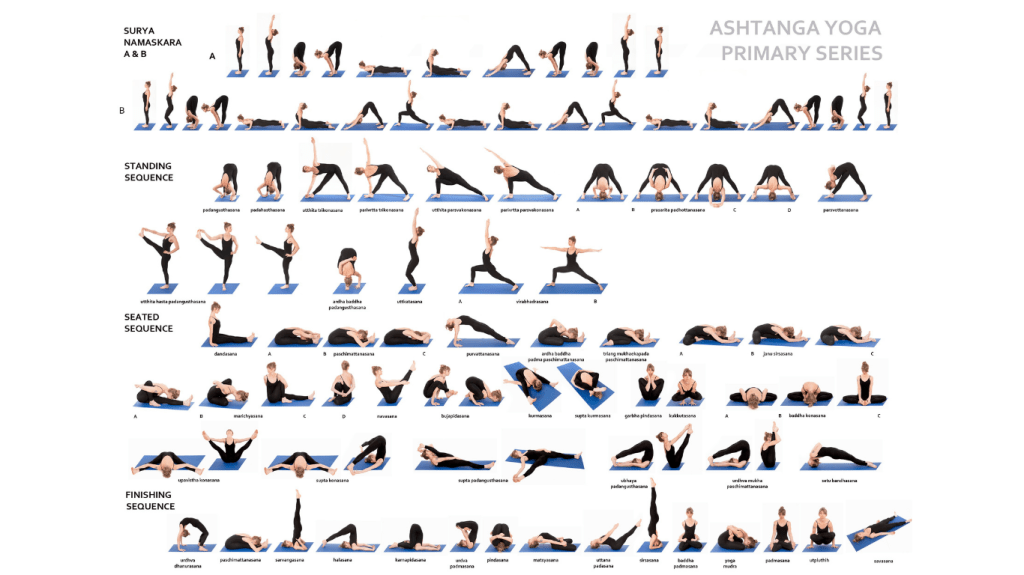
(In fact, I think I actively disliked it.)
The very first time I saw Ashtanga yoga, I hated it.
Not in a mild, “oh, this isn’t really for me” way — but in a full-bodied, judgement-heavy way. A tightening, a bracing — the part of me that stands back, arms folded internally, assuming it has nothing to learn here.
Everyone seemed to be doing the same thing, in the same order, at the same pace. Over and over again.
It looked dull. Uncreative. Almost joyless.
Worse than that, it looked impossibly difficult.
There was no breaking it down, no soft entry point, no sense that anyone might not already know what they were doing. The unspoken assumption in the room seemed to be: you should be able to do this already.
And I couldn’t.
There was very little teaching involved — at least not the kind I understand as teaching — and I left thinking, well, that’s not for me. I filed it away under things other people do and carried on with my life.
Then India complicated the story
Fast-forward to last year, practising Ashtanga every morning in India.
It was still hard. Still confronting. Still repetitive.
But something shifted.
Practising it day after day meant I began to recognise it.
I knew what was coming.
I noticed that even though the sequence stayed the same, I didn’t.
Some days it felt heavy. Some days strangely light. Some days my body said a firm no, and other days it surprised me with a quiet yes.
And during those ten days, something happened that still makes me smile when I think about it.
I went from not being able to do a wheel pose at all…
to doing one.
That wasn’t the exciting part though.
The real thrill wasn’t the pose itself — it was the evidence.
Evidence that we are not fixed.
Evidence that learning doesn’t stop.
Evidence that change is still possible, even when we think we’ve reached the edges of ourselves.
Repetition isn’t the enemy
Somewhere along the way, I stopped seeing repetition as dull and started seeing it as revealing.
When you remove novelty, distraction, and constant variation, what’s left is you.
Your habits.
Your resistance.
Your impatience.
Your quiet determination.
Ashtanga doesn’t entertain you.
It meets you where you are — whether you like it or not.
And that’s uncomfortable… until it isn’t.
Teaching it changed everything (again)
This recent experiment — teaching a beginners’ version of Ashtanga to four out of six of my in-person classes — has been a revelation.
Watching people meet this practice for the first time has been endlessly fascinating.
Some have embraced it with curiosity and enthusiasm.
Some have tolerated it politely.
Some have clearly hated it (and bless them for their honesty).
And all of it has been welcome.
Because what’s become clear is this:
there is no right response to Ashtanga.
There is only relationship.
And relationships take time.
What I’ve loved most is seeing people start to recognise the sequence, to feel less ambushed by it, to soften into the familiarity — even when it’s challenging. To notice that this time feels different from last time, even though on paper nothing has changed.
That’s not boring.
That’s alive.
A quiet love story
So no, this isn’t a dramatic love-at-first-sight story.
It’s a slow one.
A suspicious one.
A “I really don’t think this is for me” one that gradually turns into something more nuanced.
Ashtanga hasn’t replaced creativity for me — it’s given it a different shape.
It hasn’t removed freedom — it’s shown me where freedom lives inside structure.
And perhaps most importantly, it’s reminded me (again) that we are always capable of learning, adapting, and surprising ourselves — even when we think we know how the story ends.
Turns out, I didn’t hate Ashtanga after all.
I just didn’t know it yet.



 Yoga Pathways
Leave a reply to karen page Cancel reply